Thought I'd share a few little tidbits with you - just miscellanous stuff of absolutely no importance or redeeming value at all!
They have McDonald's all over the place here - they are overtaken in number only by 7-11 stores. Where as there's a McDonald's every third corner, there's a 7-11 on every corner, it seems. And while they do offer a variety of very different sauces on their burgers, you can get a Big Mac that looks and tastes the same as in the states. A little bite of home right here! I've had two since I've been here. The building and the sign for it looks the same, too. There's one notable exception that we don't have anywhere in the states though. Attached to almost every McDonald's here is an open air area with a coffee bar. Kind of like Starbucks in the open. They sell all the coffees, lattes, etc along with hot tea and cold tea. They also have a great dessert selection - trust me, I've made it my job to taste each one! They also offer "gourmet sandwiches" such as Pesto Chicken on Italian bread or Three Cheeses Grilled which comes on a variety of breads complete with tomatoes grilled on it, too. These are called McCafes and they are absolutely great! You'd never , ever know it was associated with McD's!!
They have lots of different soft drinks here. Not just ones we get back home, but also ones from China, Thailand, Indonesia, India - from all over. Same with beers -I have never seen so many different kinds from so many different places. They do not understand though when you ask for a Diet Coke or a Diet Pepsi. They are only referred to as Coke Light and Pepsi Light. That's what the can says even. They are not big on dieting here at all, so marketing-wise it works better.
One of the things they are big on here is caffeine. They have some drinks that have more caffeine in them than you could ever even believe! Makes Mountain Dew and Red Bull look like nothing! Most of the coffees that you get here are very strong, too. Basil says some of the coffee he has had just about gets up and dances around in the cup for you!
They will serve you tea anytime, anywhere. They would prefer you take it hot. Now, I like hot tea, but being a true daughter of the South, I'd rather have it ice cold. A few times I have had to play "The Game". You know the one - they tell you they don't have ice tea. Instead of arguing, I just smile sweetly, tell them yes I would love a pot of tea. Oh, and by the way, could I also have two very large glasses of just ice. They fall for it everytime! The pot comes, I mix sugar in it while it's still steaming, then with several watching me - I just very politely pour the pot of tea into my two glasses of ice. One waiter comes over very quickly and asks what I'm doing. Cooling the tea, I tell him. Oh, he says and walks away. It works and it's less hassle than trying to explain that if you have hot tea and some ice - then you can certainly have ice tea!
Asking for a glass of water can be a bit tricky, too. After the first few times, I learned. If you ask only for a water or a glass of water, many times they will bring you a glass or cup of hot water. I mean really hot water. Evidently, many Chinese people drink their water this way, it supposedly aids digestion. Okay. After ordering water a few times, then taking a big gulp only to discover it is very hot, I've learned my lesson! You must specifically tell them you want water with ice. Again, they look at me like I'm asking for something very strange!
When you encounter someone younger than you here from little kids to people in their late 20's, as a show of respect they will address you as "Auntie" or for Basil, "Uncle". And every male - except the ones from India - will address me as "m'am" or "madame". I'm waiting for it to be "Auntie Madame"! Also, they never use your last name. I am Mrs. Debbie. Even with Singapore Cargo, Basil is addressed as "Captain Charles". Very few nicknames used here.
And, for my final one today - we have a new little restaurant in the main building here at the apartment complex. They have fresh baked cookies and brownies - yes, I had to buy some and make sure they were good! They were! They have ice cream, cold drinks along with hot tea and a few sandwiches. I stopped in there this evening, thought I'd get a little something and eat light since Basil is gone and it's only me. On the menu is a hot dog. That's it, I think - haven't had a hot dog in a good long while, I'll get one to go. He made it, put it in a bag and off I went upstairs. I open it up and here's my hot dog. It's a regular size hot dog. Good start. Regular bun - okay good. Mustard - ok. No cheese. No chili - I don't think they know what chili is here. No onions. But it does have a very nice, big helping of lettuce and two slices of tomato on it! Don't believe I've ever had a hot dog with lettuce and tomato!
It's a whole new world out there! Who knew? More tomorrow!
Shari - thanks for the heads up about the insurance.
Abby- can't wait to see you ice skate!
Patsy - thanks so much for the insurance help.
Helene- so good to talk to you!
Lynn - read any good books lately?
Joyce - Happy Birthday!
Pam - Happy Birthday!
Sam - did it come yet?
Heather - still the future, still there!
Tuesday, October 2, 2007
Monday, October 1, 2007
All Things Hindu
I recently had the opportunity to tour - inside and out - a prominent Hindu temple. I hired a taxi driver to take me around the island for several hours in order to see the things I wanted to see and to have the freedom to stop whenever I wanted and take pictures.
We stopped in front of this one Hindu temple - very large and beautiful. The gates were closed and locked, so the driver just pulled off the road, kind of sideways into the little bit of driveway available to us - just to get us out of traffic. I proceeded to get out and started taking pictures through the iron fence. Then this big car pulls up behind us. It's half in the road and half in the driveway with us. Then the horn starts honking! I'm trying to get back in the taxi so we can get out of the way. That horn just keeps honking at us. Ok - you know me - I get out of the taxi and walk back to him, intending to tell him ever so politely in my best Southern manner to knock it off - we're moving out of his way - give us a second and lay off that damn horn.
Before I can say anything , this man sticks his head out the window, tells me he is the director for the temple, he'll unlock the gates and I can come inside. I thanked him and we drove in through the gate which he has opened with the remote control. I get out of the taxi and start taking pictures again of the outside of the temple. He comes over and tells me that if I will take off my shoes, I can come inside and take all the pictures I want. I was the only person there and just got to wander around for about an hour asking him all sorts of questions. It was so unbelievably beautiful - very bright colored and so incredibly detailed oriented. The taxi driver told me quietly to be sure and leave a monetary donation as we had not brought any fruit or red flowers to show honor and respect. I did and was very thankful the taxi driver reminded me. I haven't gotten an explanation on the importance and symbolism of the fruit and red flowers.
At the very end of this entry, there is some interesting information and explanations that he gave me about the Hindu religion. If that doesn't interest you, then enjoy the pictures and skip that part!
This is the outside of the temple. It was at the far end of northwestern part of the island. As with all of the temples, it is covered, but open air. The details are incredible. There is a front door, but the sides and back are all open air.


Here's where you leave your shoes - in the parking lot in front of the temple.
These lockers just sit out there all the time.
Inside the big temple, they have all these smaller temples for more individual gods that the participants of this particular temple deem to be important. Some of the other ones get a little niche in the wall. Note the stained glass windows and the medallions on the ceiling and the floor.
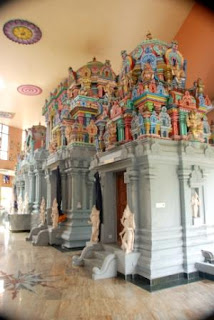
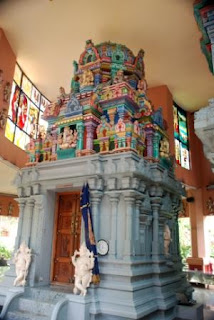
There is a clock on one of these buildings. I didn't notice it when I was there or I would have asked why it was there - just saw it in the pictures later - looks very out of place, doesn't it?

You can see where the open areas are with no windows or doors.
Check out some of the names of our local Hindu temples!
Dhandayudhapani Temple
Sri Balasubramaniam Temple
Arulmigu Velmurugan Gnana Muneeswaran Temple
Sri Vairavimada Kaliamman Temple

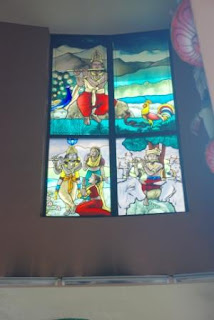
There were stained glass windows high up encircling the whole temple.
Officially, there are 26 Hindu temples in Singapore, but you see small makeshift alters and mini-temples everywhere. All along the streets, in homes, in businesses, on the sidewalks - you see these with offerings and incense burning. Stores that sell small portable mini-temples do a huge business.
I found this one as I was walking along the beach. It's in the area where the fishermen pull their boats up out of the water. They were kind enough to let me take a picture of it, but they didn't want to be in the picture. Just sitting there among the trees about 12 feet from the water's edge.


****************************************************************
***************************************************************************************
Hinduism is a religious tradition that originated in the Indian subcontinent. It is a diverse system of thought sometimes referred to as henotheistic - devotion to a single "God" of one’s own interpretation, while accepting and acknowledging the existence of other gods.
We stopped in front of this one Hindu temple - very large and beautiful. The gates were closed and locked, so the driver just pulled off the road, kind of sideways into the little bit of driveway available to us - just to get us out of traffic. I proceeded to get out and started taking pictures through the iron fence. Then this big car pulls up behind us. It's half in the road and half in the driveway with us. Then the horn starts honking! I'm trying to get back in the taxi so we can get out of the way. That horn just keeps honking at us. Ok - you know me - I get out of the taxi and walk back to him, intending to tell him ever so politely in my best Southern manner to knock it off - we're moving out of his way - give us a second and lay off that damn horn.
Before I can say anything , this man sticks his head out the window, tells me he is the director for the temple, he'll unlock the gates and I can come inside. I thanked him and we drove in through the gate which he has opened with the remote control. I get out of the taxi and start taking pictures again of the outside of the temple. He comes over and tells me that if I will take off my shoes, I can come inside and take all the pictures I want. I was the only person there and just got to wander around for about an hour asking him all sorts of questions. It was so unbelievably beautiful - very bright colored and so incredibly detailed oriented. The taxi driver told me quietly to be sure and leave a monetary donation as we had not brought any fruit or red flowers to show honor and respect. I did and was very thankful the taxi driver reminded me. I haven't gotten an explanation on the importance and symbolism of the fruit and red flowers.
At the very end of this entry, there is some interesting information and explanations that he gave me about the Hindu religion. If that doesn't interest you, then enjoy the pictures and skip that part!
This is the outside of the temple. It was at the far end of northwestern part of the island. As with all of the temples, it is covered, but open air. The details are incredible. There is a front door, but the sides and back are all open air.


Here's where you leave your shoes - in the parking lot in front of the temple.
These lockers just sit out there all the time.
Inside the big temple, they have all these smaller temples for more individual gods that the participants of this particular temple deem to be important. Some of the other ones get a little niche in the wall. Note the stained glass windows and the medallions on the ceiling and the floor.


There is a clock on one of these buildings. I didn't notice it when I was there or I would have asked why it was there - just saw it in the pictures later - looks very out of place, doesn't it?
You can see where the open areas are with no windows or doors.
Check out some of the names of our local Hindu temples!
Dhandayudhapani Temple
Sri Balasubramaniam Temple
Arulmigu Velmurugan Gnana Muneeswaran Temple
Sri Vairavimada Kaliamman Temple

There were stained glass windows high up encircling the whole temple.

Officially, there are 26 Hindu temples in Singapore, but you see small makeshift alters and mini-temples everywhere. All along the streets, in homes, in businesses, on the sidewalks - you see these with offerings and incense burning. Stores that sell small portable mini-temples do a huge business.
I found this one as I was walking along the beach. It's in the area where the fishermen pull their boats up out of the water. They were kind enough to let me take a picture of it, but they didn't want to be in the picture. Just sitting there among the trees about 12 feet from the water's edge.

One of the Indian women I have gotten to know invited me to the “children’s hour” at their local neighborhood Hindu temple. I call it Hindu Saturday School. It was, of course, on Saturday! The kids were very sweet and well-behaved. The lesson for that day was all about tolerating and respecting others, along with accepting responsibility for your own actions and how those actions affect others. All the kids listened, then actively participated in the discussion. These are a few of the kids - they ranged in age from 6 to 12 yrs old.


****************************************************************
Shari - love you! Thanks for all your help!
Abby – are you planning how you will surprise us at the airport this time?
Doug - hope you're feeling better!
Patsy - I hear you have the best brownies in town - Abby says so!
Christy & Beth - how's Ani? Smell gone? Pats and scratches from me!
Karen - Going crazy with those houses? Are we having fun yet?
Nancy - good to hear from you!
Jo – How's everything in Baton Rouge these days?
Jo – How's everything in Baton Rouge these days?
Cathy - everything going ok?
Heather - still, still
***************************************************************************************
For those of you interested, here's the other info! This was taken from a book the temple director gave me explaining some of the things I was asking about. Very interesting!
Hinduism is a religious tradition that originated in the Indian subcontinent. It is a diverse system of thought sometimes referred to as henotheistic - devotion to a single "God" of one’s own interpretation, while accepting and acknowledging the existence of other gods.
**
It is known as a conglomerate of beliefs and traditions. It has no single founder.
**
It is the world's third largest religion following that of Islam and Christianity, with approximately one billion followers, of whom about 905 million live in India and Nepal. Other countries with large Hindu populations include Bangladesh, Sri Lanka, Pakistan, Indonesia, Malaysia, Singapore, Mauritius, Fiji, Suriname, Guyana and Trinidad and Tobago.
**
Hinduism contains a vast body of scriptures that are divided as to revealed and remembered. These scriptures include theology, philosophy and mythology, providing spiritual insights and guidance in the practice of everyday living.
**
It is an extremely diverse religion. Basic beliefs overlap, but there are also many different practices and traditions overall. Each person must decide things for themselves and act upon them accordingly.
**
Prominent themes in Hindu beliefs include *Dharma (ethics/duties); *Samsāra (the continuing cycle of birth, life, death and rebirth); *Karma (action and subsequent reaction), *Moksha (liberation from the cycle of samsara - rebirth), and the *various yogas (paths or practices to enlightment).
**
Hindus believe that the spirit or soul—the true "self" of every person, is eternal.
**
The Hindu scriptures refer to celestial entities, called Devas, "the shining ones", which translates into English as "gods" or "heavenly beings”. The devas are an integral part of Hindu culture and are depicted in art, architecture and through icons, and mythological stories. Many Hindus worship a particular form or devas as their chosen ideal; the choice being based upon their individual preference, regional and family traditions. These devas can be men, women or an animal; real or mythical. These choices are reflected in their temple decorations also.
**
Karma translates literally as action, work or deed and can be described as the "moral law of cause and effect". The concept of never-failing karma relates to one's personality, characteristics and actions. It is said that karma binds together the interlockiing ideas and beliefs of free will and destiny.
**
The notion of reincarnation and karma is a strong premise in Hindu thought. It is explained: Just as a person puts on new clothes and discards the old ones, similarly a soul enters a new material body, leaving and discarding the old body.
**
This provides ephemeral pleasures, which leads people to desire rebirth in order to enjoy the pleasures of a perishable body. However, escaping the cycle of rebirth is believed to ensure everlasting eternal happiness and peace. It is thought that after several reincarnations, one eventually seeks unity with the cosmic spirit.
**
The ultimate goals of life for a Hindu are:
1.the realization of a union with one’s own interpretation of God;
2.the realization of an eternal relationship with one’s own interpretation of God;
3.the realization of the unity of all existence;
4.perfect unselfishness;
5.knowledge of self;
6.liberation from ignorance;
7.attainment of perfect mental peace;
8.detachment from worldly desires.
To reach these goals one would then be liberated and end the cycle of rebirth, thus insuring everlasting eternal peace and happiness.
**
It is a religion with a framework and guidance, but no universal scripture, not one supreme god or being and a wide latitude for personal thought, action and belief. Respect, responsibility and self discipline in all areas of life is what one aspires to. You are free to worship whatever form you deem to be supreme in your life, while acknowledging that there are always others.
**
There is no belief in hell as in the Christian religion, nor the belief in any type of punishment, just striving towards achieving eternal peace and happiness.
**
Many, but not all, Hindus are vegetarians. Some allow alcohol, many do not.
**As was explained to me, this is just a few pieces of information given as a very brief overall snapshot of Hinduism.


Saturday, September 29, 2007
Signs of the Times
 I have started collecting pictures of signs, sayings and advertisements. These are a few of my favorites!
I found this one on the outskirts of Chinatown. Anything to do with fish heads is considered a great thing here! I'm not sure exactly what fish head noodles are, but will probably not be finding out anytime soon! Also many times in the older districts, instead of calling them cafes or restaurants, they are called houses or eating houses.

We have Internet Cafes here all over the place. The government is trying to get the whole island with no cost Internet service in public places. You will still have to pay for it at your residence. You can go a lot of places - cafes, parks, etc - and just sit and use your laptop for free. So this would be for those that don't have it yet in their area. $2 Sing for an hour comes out to approximately $1.32 American. Cheap at any rate!

Islamic Montessori? I am looking now for the Buddhist and Hindu Montessori schools - I am sure they must have them! Maybe I can find one for Chinese Montessori - but would I be able to read it? Guess not! Actually, Montessori schools are very popular here - in our end of the island alone, there are 7 or 8!

This sign is next door to my favorite Mexican food place in an area called Holland Village. Strip is the name of the establishment and between the Ministry of Waxing notation and the hairy gorilla, I guess you can figure out what this place is all about. I think it's absolutely hilarious advertising!

This one isn't a sign, but I just love it! We were exploring one day and were out back of a Chinese temple when we encountered this tree. We were trying hard to guess the significance of all these newspapers hanging in the trees. You wouldn't believe all the possible explanations we came up with. One of the temple workers came out to chat with us and we asked about the newspapers. He said they tape newspaper around the budding fruits to keep the birds away while the fruit is growing and ripening. None of our guesses even came close! Imagine that! That's my friend Patsy in the picture. Her husband was also a Delta Captain and now works for Singapore Cargo, too. We do a lot of exploring and sightseeing together.

This one cracks me up everytime I see one. Yes, it's exactly as the picture depicts. Many of their crosswalks are like a giant speed bump with stripes on it. They are never called crosswalks - whether they are raised or not - just zebra crossings - many of which just happen to be raised. The first time I asked about it, the taxi driver was very specific - they have white stripes on black pavement, so they are called zebra crossings, he tells me. I wasn't about to argue with him, but for the record, most of the stripes are yellow on black pavement. But I guess that wouldn't be as much fun, would it?

These are equivalent to our No trespassing signs. Just like the picture says - they will shoot you! It's written in 6 languages just to be sure you get it!

In the US we have industrial parks - here they have estates! Doesn't matter what size it is - it's an estate. Must be a British thing!
I

This is the sidewalk sign for my favorite Mexican restaurant. The restaurant is called El Patio. They have inside and outside tables covered in serapes with white table cloths on them. The food is excellent and the margaritas great. But why this cactus has a pacifier in it's mouth beats anything I've ever seen for advertising or a logo for any kind of restaurant! I'm only from Texas - what would I know about advertising for a Mexican restaurant?
********************************************
Shari - not long now!
Abby - Mei Mei will be there soon with lots of presents!
Lynn - still hot there?
Deb Mac - read about you in the paper!
Matt - kiss Jellybean for me!
Sam - package coming!
Dinosaur - good to talk to you
Heather - still the future, still there!
Saturday, September 22, 2007
Lights, Lanterns and Mooncakes!
 It's another festival time! Because they have so many different cultures here - they celebrate them all! It seems like it is time to celebrate one thing or another every week or two. I'll try to sort out and explain the different stories and legends that go with this one.
This is a Chinese festival in origin. It's called by several different names and celebrates a couple of things, but they all seem to overlap. One name is the Lantern Festival. Another is the Moon or Mooncake Festival and, lastly, the Mid-Autumn Festival. What it's called just depends on what area of town you are in, who you are talking to and what part of China you are talking about. But they are all tied together through these traditions and legends. All of China celebrates mostly the same festivals and holidays, but because it is such a vast country, things tend to differ from one part of that country to another. Basically it's all the same celebration with regional traditions and explanations handed down over centuries.
These festivals are going on all over town. These pictures were taken down at the Clarke Quay area. It is a hugely popular area in one part of downtown where a river inlet comes into town from the sea. To me, it seems like the Riverwalk area in San Antonio, except it's larger and the river in this area is wider. Boats up and down the river, shops and restaurants lining each side, people strolling up and down the sidewalks along the river front. They set up a lot of festivals and celebrations along here. One night this coming week, we are headed across town to the Chinese Gardens, a long green area along a large lake. The lanterns there are supposed to be beautiful and plentiful.

Here's some of the info I have found:
The date of Mid-autumn Festival also known as Chinese Moon Festival is on the 15th moon day of 8th Chinese lunar month (Chicken month). The new moon day is the first day of a Chinese Lunar Month. The first day of 8th lunar month is 11th September 2007, the Moon Festival is on 25 September 2007. The time period always includes the Autumnal Equinox, the first day of fall.
This is a day to worship the moon god. According to folk legend, this day is also the birthday of the earth god (T'u-ti Kung). This festival signals that the year's hard work in the fields will soon come to an end, with only the harvest left to attend to. People use this opportunity to express their gratitude to heaven (represented by the moon) and earth (symbolized by the earth god) for the blessings they have enjoyed over the past year.The Chinese believe in praying to the moon god for protection, family unity, and good fortune. The round "moon cakes" eaten on this festival are symbolic of family unity and closeness. Pomelos are also eaten on this day. The Chinese associate these with protection and in eating them are expressing the hope that the moon god will give them protection. This is also known as a time for lovers to tryst and pray for togetherness, symbolized by the roundness of the moon. This is a lantern depicting the moon god and the lovers that are hoping he will bless them.
Moon cakes - these are "cakes" range from small to large, one layer, with a filling inside. The cakes themselves are extremely dense, very heavy. Cake in our culture generally indicates something sweet - these are most definitely not. They have lotus paste and/or sesame paste for their basis, which are not sweet in the least. The small amount of filling might sometimes be a little sweeter, but not much. The best I can describe it to you is it's like old fruitcake without the fruit. I was given some with about 7 people watching my reaction. Of course, I was shocked because i was expecting something sweet like the word suggests to me. I didn't show my distaste, but did request a glass of water as soon as it was polite enough to do so. These cakes are very popular here. Like King cakes for Mardi Gras - they are only available during this festival. Actually , as with a King cake - you can special order one at other times, but not everywhere will make one on demand. Best advice here is to steer clear of mooncakes.

Here is one of the legend that goes with them: Once, according to Chinese legend, mooncakes helped bring about a revolution. The time was the Yuan dynasty (AD 1280-1368), established by the invading Mongolians from the north. The Mongolians subjugated the Han Chinese. According to one Chinese folk tale, a Han Chinese rebel leader named Liu Fu Tong devised a scheme to arouse the Han Chinese to rise up against the ruling Mongols to end the oppressive Yuan dynasty. He sought permission from Mongolian leaders to give gifts to friends as a symbolic gesture to honor the longevity of the Mongolian emperor. These gifts were round mooncakes. Inside, Liu had his followers place pieces of paper with the date the Han Chinese were to strike out in rebellion -- on the fifteenth night of the eighth month. Thus Liu got word to his people, who when they cut open the mooncakes found the revolutionary message and set out to overthrow the Mongols, thus ending the Yuan dynasty. The dates for this legend tie in with the dates for the mid-autumn stuff.

The Lantern Festival is a festival known to be for families and children. Lantern festivals traditionally date back to 230 B.C., when Chinese began to decorate and display lanterns on streets to pray for peace and to celebrate the harvest. Such festivals can range from a few lantern-covered streets to entire cities strung with lanterns. Chinese lanterns are also specialities for this festival. The most common are the paper folding type. However, there are many varieties of lanterns made of different shapes and materials. You will see the smaller ones that are lit from inside with a candle and children carry them around extended on a stick. Many times people will attach a wish or a hope to the lantern hoping that the moon god will grant these. The lanterns range from the very small to huge things lit from within that top out at over 20 feet high. On this family occasion, parents allow children to stay up late, and take them to high vantage points to light their lanterns and watch the moon rise before eating their moon cakes. While walking along the quay where these lanterns were, you could see parents pointing out the moon to the little ones and the little ones with their stick holding their lantern. It was very sweet to watch. All the pictures you see here are of the lanterns on display. They look to me a lot like giant balloons. But they are not. Many are made with paper and coated with wax in case it rains. Others are made from a stiff plastic and can stand alone.
 The moon has long been an object of curiosity and worship in many Asian cultures. To the most ancient ancestors of the Chinese, the sun and the moon were considered the "chief objects of veneration. In ancient Asian mythology, there is a strong relationship between the moon and water. The moon is said to regulate reservoirs and supplies of water. There is a suggestion that the moon produces fertility and freshness in the soil. The moon's role in bountiful harvests is widely recognized during autumns around the world. This lantern depicts the sea and our famed "pink dolphins".
In Chinese celestial cosmology
 , the moon represents the female principle, or yin.
During ancient autumn Moon Festivals, women took center stage because the moon is considered feminine. Only women took part in Moon Festival rituals on the night of the full moon. Altars would be set up in households, and when the full moon appeared, women would make offerings of incense, candles, fruit, flowers, and mooncakes.
The legend of the Moon Goddess, Chang O (Chang-E in other translation), reflects the feminine principle of yin, as opposed to the masculine principle of yang, which is symbolized by the sun.
The legend of the moon goddess is that she was a beautiful woman held prisoner by a king who wanted no one else to view her beauty. She was very unhappy and prayed to the moon god to help her. Miraclously, one night right in front of the king's eyes, she floated up to the moon and lives there shining the moon's glow on things to highlight their beauty because of her beauty. Girls are taught from an early age to pray first to the moon goddess that they will be beautiful, then next they pray to her to find them an attractive mate and lastly, that they may have beautiful children. This is the Moon Goddess depicted on top of this lantern.
 Absolutely nothing Chinese would be true or complete without the dragon or dragons to guard and protect everything. They and the color red are predominate in this culture, though the color red also extends into and plays a huge role in Indian culture also.
So there you have it! And I always thought it was only the man in the moon up there! You know they say - behind every good man is a woman - so true in all legends and cultures!
Love to you Shari and Doug!
Abby - I bought you some lanterns!
Kelly - hope you have enjoyed reading this!
Doreen - quite the adventure, huh?
Patsy - won't be long now!
Lynn - can't wait
Heather - still the future, still there
Subscribe to:
Posts (Atom)


